
In most situations, no, it is not safe to keep driving with low tire pressure for longer than it takes to fix it. If a tire is only 2 to 3 PSI below the recommended level, the risk is usually not immediate, but the tire is already no longer working exactly as intended.
If it is 5 to 8 PSI low, braking, steering response, tread wear, and fuel economy are already being affected in a meaningful way. If it is 10 PSI or more below spec, or visibly low, it should be treated as a real safety issue rather than a small maintenance problem.
At that point, the tire is flexing too much, building too much heat, and becoming more vulnerable to sidewall damage, pothole damage, or failure at speed.
What “Low Tire Pressure” Actually Means
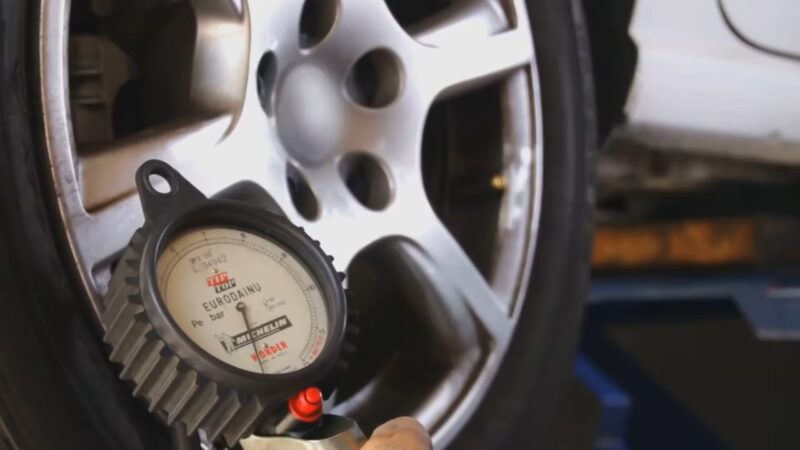
The correct tire pressure for normal driving is not the maximum PSI printed on the sidewall. It is the number listed on the sticker inside the driver’s side door jamb.
On many passenger cars, that number is somewhere around 32 to 36 PSI, though some vehicles are lower, and some SUVs, trucks, and EVs may be higher. What matters is the vehicle’s own specification.
A good practical example helps here. If your car calls for 35 PSI cold and one tire is at 33 PSI, that is slightly low. You should correct it, but it is usually not an emergency. If that same tire is at 28 PSI, that is already a meaningful drop.
The tire is doing more work than it should every time it rotates. If it is at 24 PSI, that is no longer something to casually keep driving on, especially not at highway speed. If it is down near 20 PSI or lower, or the tire visibly looks soft, the car should not be treated as normally drivable.
Practical Pressure Guide
Recommended Pressure
Actual Pressure
What It Means In Practice
Risk Level
35 PSI
33–34 PSI
Slightly low, should be corrected soon
Low
35 PSI
30–32 PSI
Tire performance has already been reduced
Moderate
35 PSI
25–29 PSI
Heat buildup and wear increase noticeably
High
35 PSI
20–24 PSI
Unsafe for normal driving, especially at speed
Very high
35 PSI
Below 20 PSI
Severe underinflation, possible tire damage
Extreme
This is why the answer cannot just be yes or no. There is a real difference between a tire that is a little low and a tire that is dangerously low. But even the smaller problem should be corrected quickly, because underinflation rarely improves on its own. It usually gets worse.
Why Low Pressure Becomes Dangerous
A properly inflated tire carries the vehicle’s weight with the correct shape and contact patch. When pressure drops, the tire squats more and the sidewall bends more. That sounds small, but the consequences are not small.
More flex means more internal friction, and more friction means more heat. Heat is what turns low pressure from a maintenance issue into a safety issue.
For example, imagine a car with one front tire 8 PSI low on a hot day. Around town at 40 km/h or 25 mph, the tire may survive the trip without drama. Put that same car on the highway at 110 km/h or 68 mph for 45 minutes, and now the tire is flexing thousands of times under much heavier heat stress.
Add luggage or passengers, and the risk rises again. The tire may not fail, but the conditions are clearly worse for it, and the margin of safety is much lower.
Real Effects You Can Notice On The Road
Low tire pressure changes how the car behaves, but sometimes the signs are subtle at first. That is why it is useful to think in terms of real driving examples instead of vague warnings.
If a front tire is low, the steering may feel a little slower or heavier. The car may feel less sharp going into turns. If one tire is lower than the others, the car may drift slightly to one side.
During braking, the car may feel less planted. On the highway, a low tire can make the vehicle feel a bit soft or less stable when changing lanes.
The fuel economy effect is also real. A tire that is notably underinflated creates more rolling resistance, which means the engine has to work harder. The difference is not always huge from one day to the next, but over time, it adds up.
The same is true of tire wear. An underinflated tire tends to wear faster on the outer edges because the tread is no longer meeting the road evenly.
Concrete Examples By Driving Situation
Situation
Example
How Serious Is It
Small pressure drop
The tire should be 35 PSI, but it is at 33 PSI
Usually okay for a short drive, but refill soon
Moderate underinflation
The tire should be 35 PSI, but it is at 29 PSI
Noticeably worse for wear, handling, and fuel use
Highway risk
The tire should be 35 PSI, but it is at 26 PSI. A highway trip is planned
High risk, should be corrected before driving
Heavy load risk
The SUV tire should be 38 PSI, but it is at 30 PSI with passengers and luggage
High risk because the load increases tire stress
Severe low pressure
The tire should be 35 PSI, but it is at 22 PSI
Unsafe for normal driving
Near-flat situation
Tire visibly sagging, TPMS light on, car feels unstable
Stop and fix before continuing
Is A Short Drive Ever Acceptable?

If your car calls for 34 PSI and one tire is at 31 or 32 PSI, it is generally reasonable to drive a short distance to a gas station and correct it. That is very different from continuing to work, driving on the highway, or ignoring the issue for a week.
A more concrete way to think about it is this:
Why Highway Driving Changes Everything
@diamond_lawyers What are the risks of driving with low #tirepressure? 🚙 Safety Ambassador, Cam Woolley, explains the dangers and discusses how to check your tire pressure levels. #tiresafety #tires #wintertires #snowtires #safetytip #safetyvideo #safety #tipoftheday #explainervideo #lawyersoftiktok #lawyers #lawyertiktok ♬ Creekside – Hz. & ultmt.
Speed makes low tire pressure more dangerous. At lower city speeds, the tire still suffers, but heat buildup happens more slowly. At highway speed, the tire flexes rapidly and continuously, which pushes the temperature up much faster.
Take two examples. In the first, a sedan with a tire at 30 PSI instead of 35 PSI drives 3 kilometers through town to a service station. That is not ideal, but it is usually manageable. In the second, the same car drives 150 kilometers on the highway in summer with that same underinflated tire.
How Much Lower Than Recommended Is Too Low?
Drivers often want one exact cutoff number, but the better answer is a range. Once a tire is around 25 percent below the recommended pressure, the problem is serious enough that normal driving is no longer a good idea.
For example:
Recommended PSI
25% Low Threshold
What That Means
32 PSI
24 PSI
Serious underinflation
35 PSI
26 PSI
Serious underinflation
36 PSI
27 PSI
Serious underinflation
40 PSI
30 PSI
Serious underinflation
So if your door sticker says 35 PSI and the tire is reading 26 PSI, that is not just “a bit low.” That is deeply underinflated and should be treated accordingly.
The TPMS Light Matters More Than Many Drivers Think
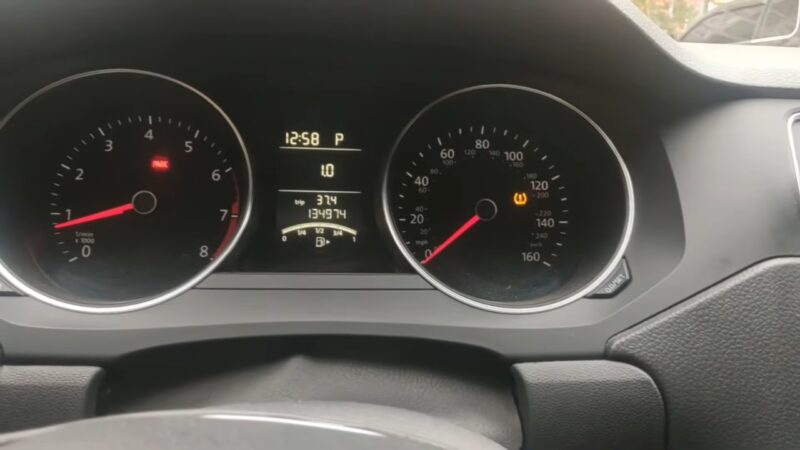
A lot of cars turn on the tire pressure warning light when one or more tires drop significantly below the target pressure. On many vehicles, that trigger may be somewhere around the low-20-percent range, though it varies by system.
That means when the warning light comes on, the pressure is often not just slightly off. It may already be far enough below spec to matter.
A common real-world example is winter weather. A tire set to 35 PSI on a mild afternoon may drop to 30 or 31 PSI after a cold night.
The driver may not feel much difference, but the TPMS light comes on because the tire has crossed the system’s threshold. That is not a reason to panic, but it is a reason to check and correct the pressure, not ignore it.
Common Real-World Causes
Low tire pressure usually comes from one of a few practical causes. Sometimes it is just temperature. Sometimes it is damaged.
Cause
Real Example
Temperature drop
The tire was 35 PSI last week, now 31 PSI after a cold snap
Slow puncture
A nail in the tread causes a loss of 1 to 2 PSI per day
Bad valve stem
The tire keeps dropping gradually with no visible tread damage
Wheel or bead leak
The tire loses pressure after hitting a pothole
Poor maintenance
Tires have not been checked in months
Post-service issue
The tire shop set pressures unevenly after the rotation
These examples matter because they help the reader understand whether the problem is a one-time adjustment or a leak that will keep coming back.
What Can Happen If You Ignore It
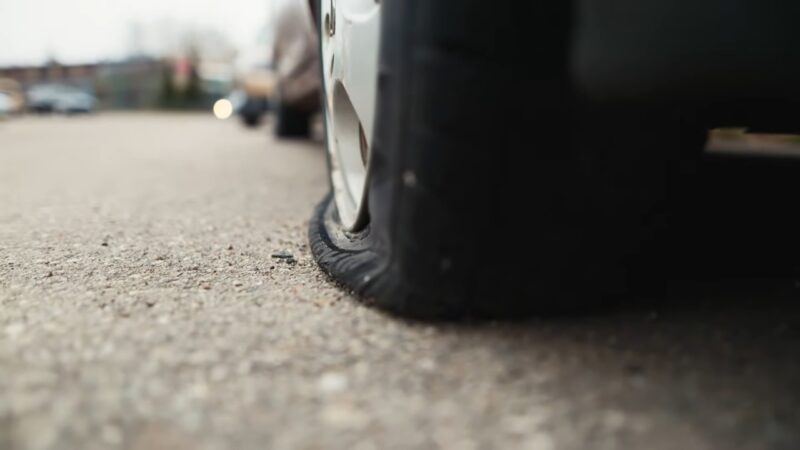
Driving on low-pressure tires long enough can permanently damage the tires. This is important because many people assume they can just add air later and everything goes back to normal. That is not always true.
If a tire is driven while severely underinflated, the internal structure may be weakened by heat and repeated flexing. The tire can look better once aired back up, but the damage may already be done.
That is especially true if the car was driven at speed with pressure far below spec. This is one reason a near-flat tire should not simply be reinflated and trusted without closer inspection.
What To Do Right Away
The best response is not complicated. Check the pressure with a gauge, not by eye. Compare it to the door-jamb recommendation. If the tire is only slightly low, add air immediately and recheck it.
If it is far below spec, visibly low, or losing air again soon after inflation, stop treating it as a simple refill issue and assume there may be a puncture or leak.
A short practical checklist is enough here:
Final Thoughts
View this post on Instagram
So, is it safe to drive with low tire pressure? Only in a limited, short-term, fix-it-immediately sense when the pressure is just slightly below spec.
Beyond that, the answer becomes no very quickly. A tire that is 2 or 3 PSI low is a maintenance issue that needs prompt correction. A tire that is 6, 8, or 10 PSI low is already a safety issue.
A tire that is around 25 percent below the recommended pressure, visibly soft, or unstable on the road should not be trusted for normal driving.